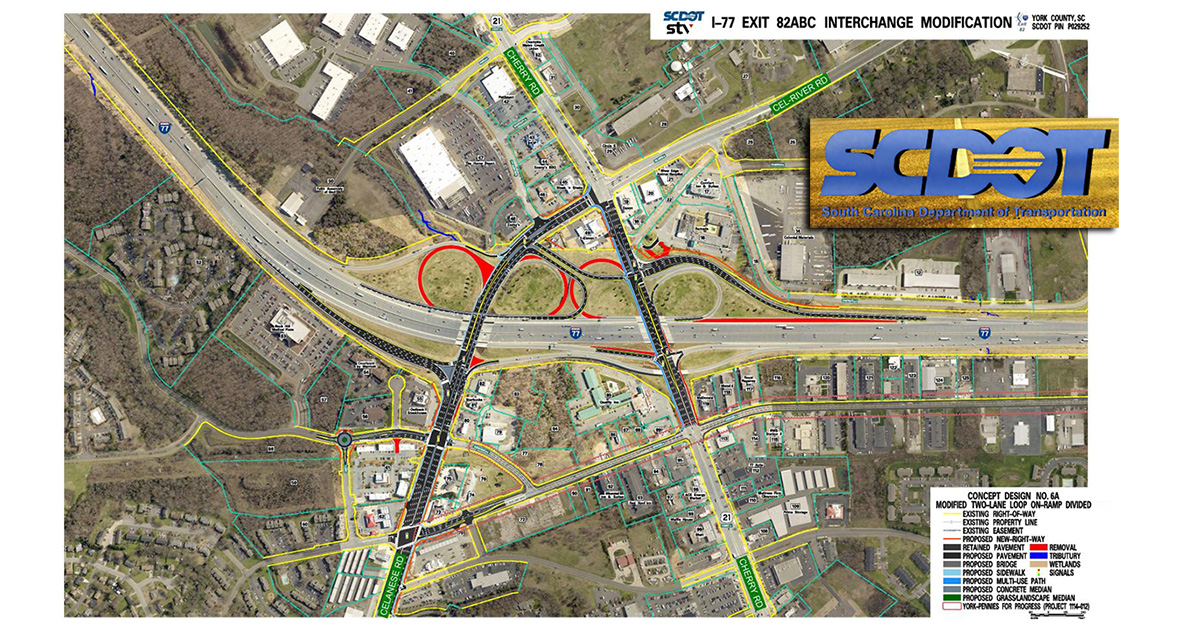
Plans to overhaul the Interstate 77 Exit 82 interchange are moving ahead, but the $106 million project is already raising concerns about funding shifts, cost overruns, and long-term impacts on York County taxpayers.
York County confirmed it will contribute $11 million to the upgrade, joining state and infrastructure bank funding to redesign one of the region’s most congested interchanges. SCDOT will rework Exits 82A, 82B, and 82C to improve traffic flow along Celanese Road and Cherry Road—two critical commuter corridors connecting Rock Hill and Charlotte.
Heavy Congestion Drives the Push for Change
Traffic routinely backs up through multiple intersections during morning and evening peak hours as drivers jockey for I-77 access. Southbound traffic often slows on the interstate itself as vehicles stack at the ramps. SCDOT plans to present several redesign concepts to the public next year, with construction possible by 2028.
Funding Moves Forward—But Not Without Tension
The project will rely on a complex funding package involving York County, the S.C. Transportation Infrastructure Bank, and SCDOT. The county first requested support in 2019, ultimately securing part of a $75 million bank award for Exits 82 and 85.
However, the process has been marked by several red flags:
1. Attempted Reallocation From Exit 90
In 2024, York County considered diverting $64 million from the Exit 90 (Carowinds Boulevard) project to cover Exit 82 costs.
RFATS committee members called the plan “robbing Peter to pay Paul,” and residents in northern York County voiced strong opposition. The shift would have delayed improvements at Carowinds and Fort Mill, prompting officials to pull back the proposal.
2. Massive Cost Overruns in Nearby Projects
Exit 85’s cost jumped from $50 million to $115 million by mid-2023—more than double the initial estimate.
The spike raised concerns about SCDOT’s forecasting reliability and sparked fears that Exit 82 could face similar overruns. SCDOT added a 10% contingency to try to prevent repeat issues, but no firm cost guarantees exist.
3. Timeline Risks
York County remains tied to long-term debt from the Fort Mill interchange project until 2031, limiting its flexibility if costs rise or additional money is needed.
Construction bids are expected in 2026 or 2027, leaving several years for inflation, design changes, or supply cost spikes to impact the budget.
4. Transparency Questions
SCDOT continues to get pressed for clearer cost breakdowns and justification for rising estimates, but to date, no formal investigation exists.
Next Steps
SCDOT will reveal formal redesign concepts in 2026, followed by public comment sessions and additional environmental reviews.
The next RFATS policy meeting — scheduled for January 2026 — will focus on finalizing funding agreements and addressing remaining concerns.