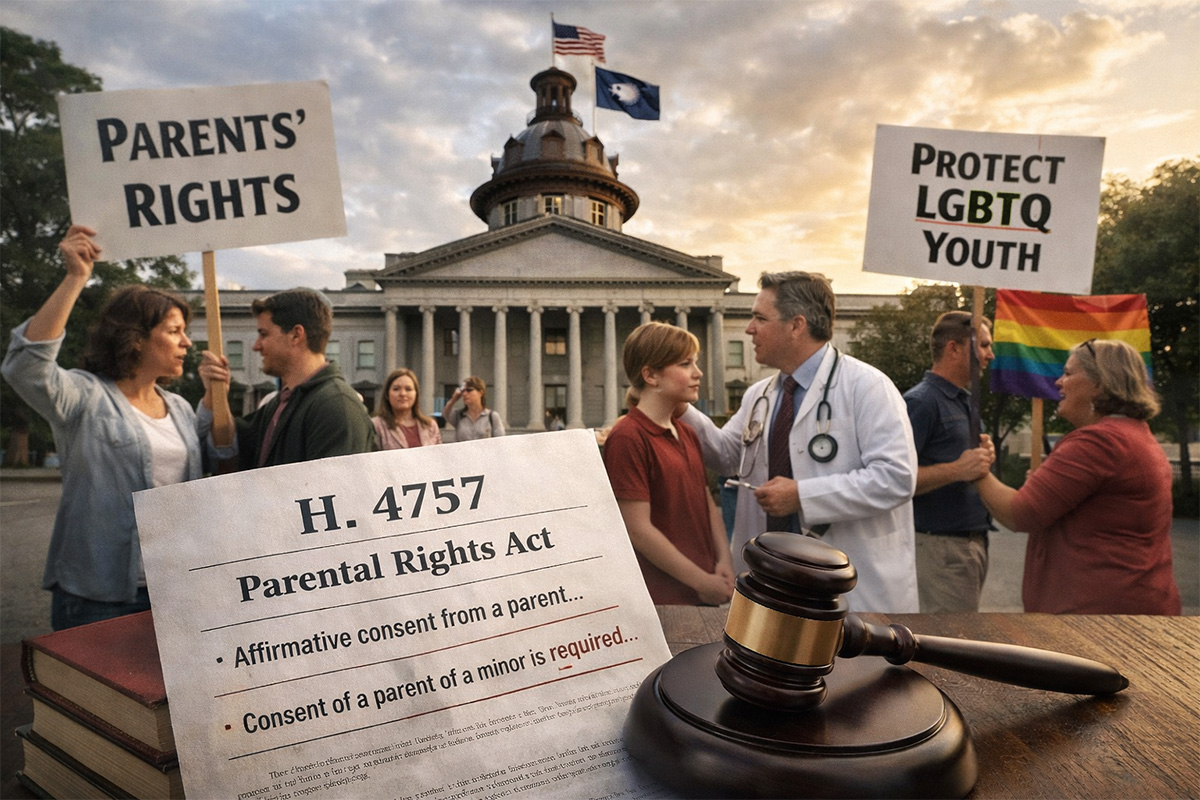
A sweeping proposal at the South Carolina Statehouse—House Bill 4757, titled the “Parental Rights Act”—would rewrite how schools and health providers handle parent access, consent, and disputes. The bill also creates new enforcement tools, including a path to lawsuits and set-dollar penalties.
Details
What the bill would do in schools
1) Require parental notice and “affirmative consent” for certain topics
Local school districts would have to adopt policies that require “at least five days’ notice” and “affirmative consent” before a student attends instruction or presentations about “gender identity…or sexual orientation.”
Under Section 59-28-340, Local Education Agencies (LEAs) must adopt parental rights policies:
“Procedures requiring “[**a]t least five days’ notice to, and affirmative consent from, a parent before the child attends any instruction or presentation that has the goal or purpose of studying, exploring, or informing students about gender roles or stereotypes, gender identity, gender expression, or sexual orientation.”
2) Broaden what counts as “educational records”
The definition of “educational records” is extensive, expressly including items such as “counseling records,” “psychological records,” and “teacher and counselor evaluations.”
4) Restrict withholding information from parents
It states state employees (with narrow carve-outs) may not “encourage or coerce” a child to withhold information from a parent and may not withhold information relevant to a child’s health, including requests to be treated inconsistently with sex.
What the bill would change in minor healthcare consent
Our state’s current laws allow for a minor 16 or older to consent to health services without another person’s consent. HB 4757 would replace that structure with a general requirement that a parent’s consent is required before a provider procures, refers, or renders healthcare—except in listed situations.
The bill lists exceptions, including emergencies, prehospital care, emergency care at an accident, first aid, and prenatal/delivery/neonatal or postnatal care in specified circumstances for a child 14+.
It also repeals two current sections related to furnishing health services to minors without parental consent and certain consent rules.
Enforcement: complaints, investigations, and lawsuits
Administrative complaints first
Parents would start with a written complaint at the district level; unresolved matters can be appealed to the State Board of Education.
Private lawsuits after exhaustion
After exhausting administrative remedies, the bill authorizes a lawsuit and specifies recoverable remedies, including “liquidated damages of five thousand dollars per violation.”
It also outlines an Attorney General role for complaints involving non-school entities and for enforcing parts of the framework.
Effective date
The bill would begin applying to actions after June 30, 2026, and takes effect July 1, 2026.
Background Information
Who is behind it
HB 4757 was prefiled Dec. 16, 2025, and introduced Jan. 13, 2026, then referred to the House Medical, Military, Public and Municipal Affairs Committee.
The official sponsor list for HB 4757 shows 57 Republican representatives signed on as sponsors, including 8 members of the ultra-conservative Freedom Caucus.
Who is against it—and why
SC Equality is organizing opposition and warns the bill could increase outing pressures, censor school content, threaten support groups, and reduce confidential care access for minors.
ACLU of South Carolina criticizes the bill as “censoring teachers” and highlights the opt-out and advance-notice requirements as burdensome and chilling for classroom discussion.