

A growing battle over privacy, police surveillance and constitutional rights is reaching South Carolina. A new proposal in Congress could eventually force communities across the Palmetto State to choose between keeping Flock Safety cameras and keeping millions of dollars in federal funding.
On July 25, U.S. Rep. Thomas Massie (R-Ky.) announced plans to introduce legislation that would withstrong federal funding from municipalities and law enforcement agencies operating Flock Safety or similar automated license plate reader (ALPR) systems. Rather than banning the cameras outright, the proposal would use federal grant money as leverage, targeting grants from agencies such as the Department of Homeland Security, Department of Justice and highway safety programs.
“The Bill of Rights is not a suggestion, and Fourth Amendment protections against warrantless searches conducted by the government are not optional,” Massie said while announcing the proposal.
I’ll soon be sponsoring a bill to withhold federal money from municipalities and police departments that deploy Flock (and other style) cameras to surveil law abiding citizens. pic.twitter.com/FGzE69psxS
— Thomas Massie (@RepThomasMassie) July 25, 2026
South Carolina has rapidly embraced Flock cameras
Flock Safety cameras have spread across South Carolina in recent years, including in York County, Greenville County, Chesterfield County, Bluffton, Hilton Head, Greer, Irmo and numerous other communities.
The cameras automatically photograph every passing vehicle, recording its license plate, location, date, time, make, model and color. That information is stored in a searchable database that participating law enforcement agencies can access without first obtaining a warrant.
Supporters say the technology has become one of law enforcement’s most effective investigative tools, helping recover stolen vehicles, locate missing children, solve homicides and identify fleeing suspects.
Critics argue the system creates a searchable database of millions of innocent drivers who have never been suspected of committing a crime.
Recent South Carolina controversies have intensified the debate
The privacy debate has accelerated after several recent incidents involving Flock cameras in South Carolina.
As Charlotte Stories first reported, two local officers were fired after an internal audit determined they had improperly used the department’s Flock system. Records later showed one officer allegedly searched the system to monitor another officer with whom he had a personal relationship, while another allegedly searched multiple citizens using false investigative justifications.
Less than two weeks later, Greenville County Sheriff Hobart Lewis announced that two Greenville County Sheriff’s Office employees were also terminated after an audit found they had misused the department’s Flock camera system.
The controversy isn’t limited to law enforcement.
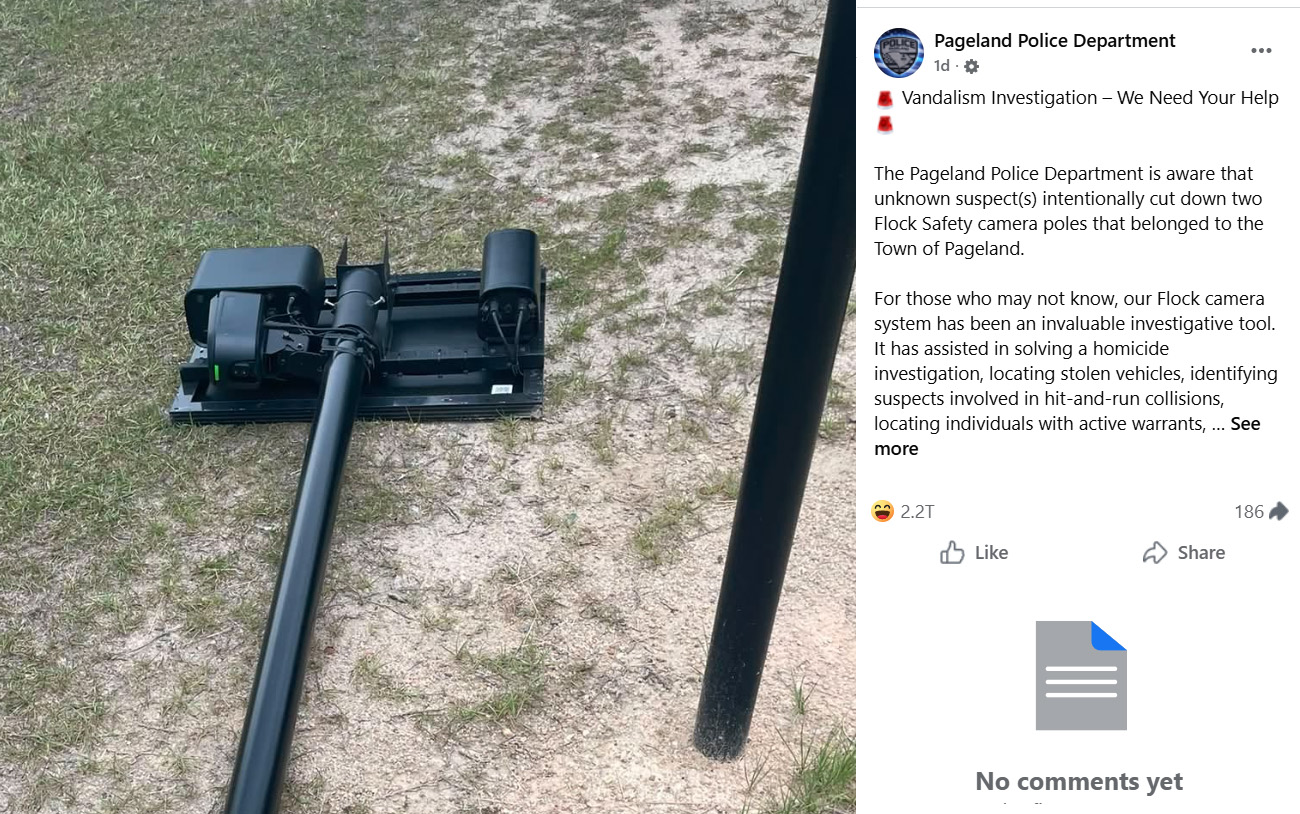
Earlier this summer, two Flock camera poles were intentionally cut down in Pageland, prompting a criminal investigation and igniting debate throughout the region over government surveillance and privacy.
Where South Carolina’s elected officials stand
Unlike Massie, South Carolina’s congressional delegation has largely remained silent on Flock cameras specifically.
However, their broader records offer clues about how they have approached surveillance and policing.
Rep. Ralph Norman (R-SC) has consistently advocated for limited government, stronger Fourth Amendment protections and reducing federal overreach. He has supported efforts to reform or limit federal surveillance authorities, particularly involving warrantless government data collection. However, he has not publicly stated a position on Flock cameras or automated license plate readers.
Rep. Russell Fry (R-SC) has built much of his congressional platform around supporting law enforcement, border security and tougher criminal enforcement. He has not publicly addressed Flock cameras or ALPR technology.
Sen. Tim Scott (R-SC) has supported expanding police body camera programs while simultaneously backing criminal justice reforms such as the First Step Act. His public record reflects support for accountability in policing alongside strong backing for law enforcement, but he has not taken a public position on Flock cameras.
Rep. Nancy Mace (R-SC) has frequently criticized government overreach and advocated for stronger privacy protections involving technology and data security. She has not publicly commented on Flock Safety systems.
Rep. Joe Wilson (R-SC), Rep. William Timmons (R-SC), Rep. Sheri Biggs (R-SC) and South Carolina’s other members of Congress also have not publicly announced positions on Massie’s proposal or on automated license plate reader systems.
If Massie’s legislation advances, South Carolina’s delegation will likely face increasing pressure to clarify where they stand.
Crime-fighting tool or mass surveillance?
The debate ultimately comes down to competing priorities.
Law enforcement agencies argue Flock cameras help solve crimes more quickly while reducing investigative workloads. The company says its technology has assisted in more than 1 million investigations nationwide and helped locate more than 10,000 missing people.
Privacy advocates counter that the cameras record information on virtually every passing vehicle, regardless of whether the driver has committed any crime. They argue that creating long-term databases of innocent citizens’ movements raises serious Fourth Amendment concerns.
Massie’s proposal follows other efforts in Congress to limit mass surveillance. Rep. Tim Burchett (R-Tenn.) has introduced legislation that would prohibit federal agencies from purchasing Flock cameras and require deletion of stored data after 30 days, while other lawmakers have proposed requiring warrants before accessing long-term location information.
A growing issue for South Carolina
Whether Massie’s proposal becomes law remains uncertain.
What is certain is that South Carolina is no longer watching the national surveillance debate from the sidelines.
With Flock cameras expanding across the state, officers recently fired for abusing the system, cameras vandalized in Pageland and Congress now considering financial penalties for agencies that use the technology, the Palmetto State has become one of the places where the future of automated police surveillance may ultimately be decided.