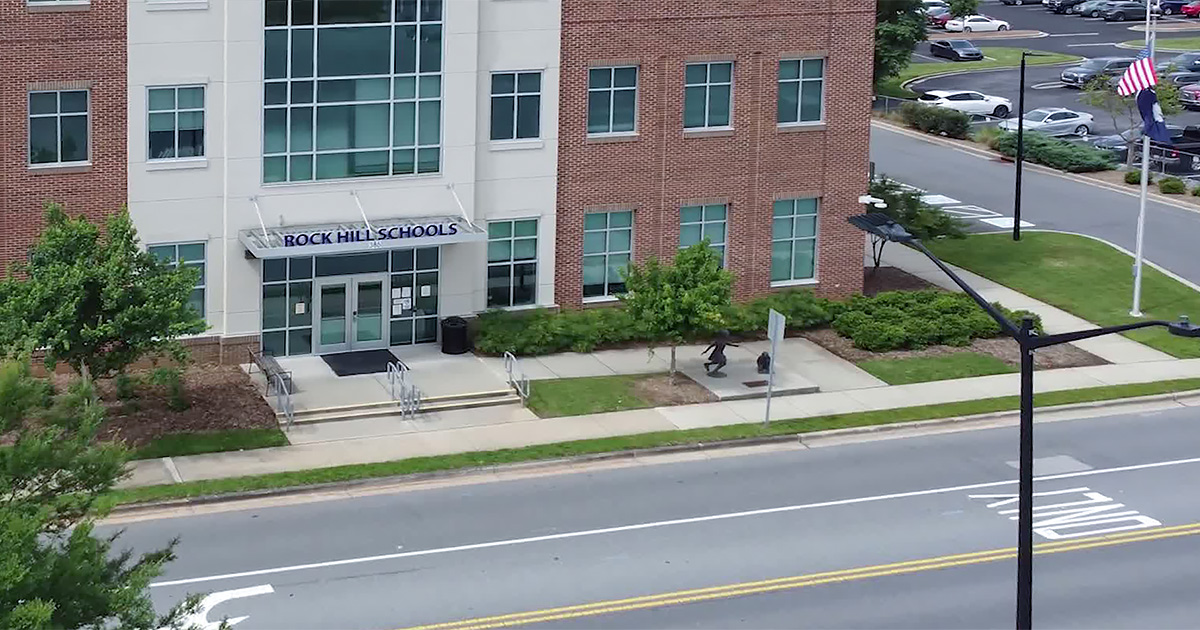
York County Council’s June 2026 decision to restructure the Octapharma FILOT so that the City of Rock Hill gives up 100% of its potential tax revenue — while the Rock Hill School District only forgoes 31.9% — represents a necessary correction that finally puts schools ahead of municipal convenience. However, this one-time adjustment does nothing to fix the much larger, decades-long revenue hemorrhage caused by the Downtown TIF, which continues to divert tens of millions from the school district every decade.
The Downtown TIF: A 38-Year-Old Freeze on Growth
The Downtown TIF was created in December 1988. The original frozen base assessed value was just $1,518,498 (later adjusted downward in 1991 and with additional base value added for a 2012 expansion). All property value growth above that 1980s-era base has been diverted to the TIF for nearly four decades.
According to the Rock Hill School District’s own statements in a 2023 lawsuit, the district has already forfeited approximately $85 million in tax revenue from the Knowledge Park area alone over a 30-year period due to the TIF. Through June 30, 2019, the Downtown TIF had captured more than $4.53 million in school district incremental taxes, according to an independent 2020 review by Greene Finney, LLP commissioned by York County.
The combined Downtown/Textile TIF district is now scheduled to run until December 31, 2039 — meaning another 13+ years of diverted revenue.
If the TIF did not exist, the Rock Hill School District would be receiving the full school portion of property taxes on all value growth in the district since the late 1980s — growth that includes major public and private investments in Fountain Park, White Street improvements, parking infrastructure, and Knowledge Park.
The Octapharma FILOT: City Gets Nothing for 40 Years
In June 2026, York County Council approved a FILOT agreement for Octapharma Plasma’s $1.5 billion manufacturing and headquarters project on the former Carolina Panthers site in Palmetto Research Park. The deal includes a reduced 4% assessment ratio for 40 years plus additional layered discounts (50% off the fee in years 1–10, 35% in years 11–20, and 20% in years 21–30).
Under an amendment proposed by Councilman William “Bump” Roddey and passed 5-2, the burden was reallocated so that:
- York County forgoes 50% of its share.
- Rock Hill Schools forgoes only 31.9% of its share.
- The City of Rock Hill forgoes 100% of its potential property tax revenue from the project.
As a result, the City of Rock Hill will receive no property tax revenue from this $1.5 billion investment for the next four decades. The school district will receive a reduced but still meaningful share, while the City — which owns the land and will provide city services — gets nothing.
Rock Hill Schools’ Broader Financial Picture
The Rock Hill School District already operates under significant constraints. Like many South Carolina districts, it relies heavily on local property taxes to fund operations, facilities, teacher salaries, and programs. Every dollar diverted through long-term TIFs and one-sided FILOT deals reduces the district’s ability to keep pace with enrollment growth, facility needs, and competitive compensation.
The district has previously accepted reduced revenue in exchange for specific benefits (such as educational space commitments in Knowledge Park). However, critics argue that the cumulative impact of multiple long-term incentive deals is creating structural budget pressure that affects classrooms today and for years to come.
Why Major Changes Are Needed
The combination of a nearly 40-year-old TIF with a frozen 1980s base and a new 40-year FILOT that gives the City zero revenue from a transformative project reveals a pattern: Rock Hill is repeatedly asked to carry a disproportionate share of the cost of economic development while schools and county services absorb long-term revenue losses.
Key problems include:
- Excessive term lengths — Both the TIF (through 2039) and the new Octapharma FILOT (40 years) lock in revenue diversion for generations.
- Weak protections for the City’s own revenue — The City has accepted deals where it receives little or nothing while still providing services.
- Lack of transparency and specificity — A 2020 independent review criticized the City for vague project plans that gave it too much flexibility to shift spending without returning to other taxing entities for approval.
- Ongoing General Fund subsidies — The City has used its own general revenue to cover TIF shortfalls.
Without major reforms — including shorter maximum terms, stronger revenue-sharing requirements that protect the City’s own share, more specific project commitments, and better coordination with the school district — these patterns will continue. The result is a slow but steady erosion of resources available for Rock Hill’s students and public services, even as the city successfully attracts large-scale investment.
The data is clear: the current approach is not sustainable. Rock Hill needs a new framework for economic development incentives that balances job growth with long-term fiscal health for all taxing entities — especially its schools.